Diesel Truck problems & Diagnostics | Springtown, TX
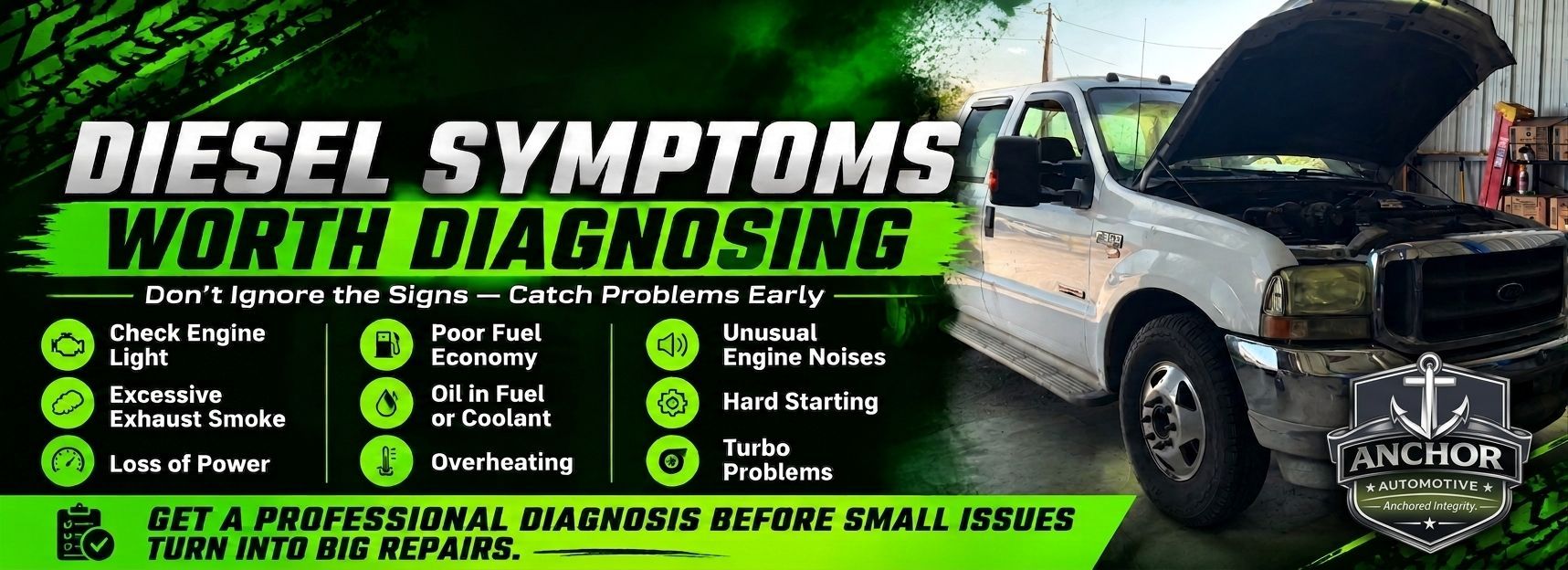
Diesel Truck problems in springtown, tx: why proper diagnosis matters
A diesel truck that suddenly loses power under load tells you something important right away - the problem needs to be diagnosed, not guessed at. If you are searching for diesel repair Springtown TX drivers can count on, the real question is not who can replace parts fastest. It is who can confirm the cause of the failure before your time and money get burned on the wrong repair.
That matters even more for diesel owners who tow, haul, commute, or depend on a work truck every day. A repeat breakdown is not just inconvenient. It can cost a day on the job, a missed delivery, or a stranded weekend with the family. Good diesel repair protects reliability. Great diesel repair starts with proof.
What diesel repair in Springtown TX should actually look like
Too many diesel problems get treated like a menu of common parts. Low power? Maybe a turbo issue. Check engine light? Maybe a sensor. Hard start? Maybe injectors. Sometimes those guesses land close enough to work. A lot of times they do not.
A disciplined diesel repair process starts with the symptoms, verifies the complaint, pulls the right fault data, and tests the system that can actually produce that failure. That can include boost control, fuel delivery, air metering, electrical inputs, exhaust aftertreatment behavior, and mechanical condition. The point is simple - test it, prove it, fix it.
That approach often protects owners from repeat visits. It also helps separate a root-cause failure from a secondary code. On modern diesel trucks, one problem can trigger several symptoms. Replacing the component named in a code without verifying the failure can send you in the wrong direction.
Common diesel symptoms that deserve real testing
Diesel trucks usually give warning signs before a major failure. The mistake is assuming the symptom tells the whole story. Loss of power while towing, excessive smoke, hard starting, poor throttle response, limp mode, rough running, rising regen frequency, and check engine lights can all come from more than one source.
For example, power loss can come from boost leaks, actuator control problems, fuel supply issues, restricted exhaust flow, sensor errors, or mechanical trouble. A hard start may point toward battery and cranking performance, fuel pressure bleed-down, glow system faults, injector concerns, or compression-related problems. Similar symptoms do not always mean similar repairs.
That is why clear testing matters. It narrows the failure down to facts. It also gives you a repair path that makes sense instead of a stack of possibilities.
DURAMAX, POWERSTROKE, AND CUMMINS DIESEL REPAIR
Not every diesel truck is built the same. GM Duramax, Ford Powerstroke, and Ram Cummins trucks use different engine designs, fuel systems, electronics, turbocharging systems, emissions equipment, and control strategies.
That means diesel diagnosis should take the specific truck and engine platform into consideration.
GM DURAMAX DIESEL REPAIR
GM Duramax trucks are popular throughout Springtown and the surrounding North Texas area because of their towing, hauling, and work capabilities. When a Duramax develops a problem, symptoms may include loss of power, hard starting, excessive smoke, rough running, poor fuel economy, warning lights, or reduced-power operation.
Duramax problems can involve fuel delivery, air and boost control, sensors, electrical systems, emissions components, or mechanical systems. The symptom you notice is not necessarily the component that has failed.
If your Duramax is behaving differently than normal, proper testing can help determine what is actually causing the problem before unnecessary parts are replaced.
FORD POWERSTROKE DIESEL REPAIR
Ford Powerstroke trucks are commonly used for work, towing, hauling, and everyday driving. When a Powerstroke develops a drivability or performance problem, several different systems may produce similar symptoms.
Powerstroke owners may notice hard starting, loss of power, poor throttle response, excessive smoke, rough running, warning lights, reduced-power operation, or problems that only appear while towing.
A Powerstroke that runs normally around town but loses power under a heavy load may require a different diagnostic approach than a truck with a constant problem. Operating conditions can provide important clues about where the failure needs to be investigated.
Whether you depend on your Ford Powerstroke for work or use it to tow on the weekends, identifying the root cause can help reduce downtime and prevent repeat repairs.
RAM CUMMINS DIESEL REPAIR
Ram trucks equipped with Cummins diesel engines are well known for their towing and heavy-duty capabilities. However, high mileage, heavy loads, long operating hours, and normal wear can eventually lead to fuel, electrical, air, emissions, or mechanical problems.
Common Cummins symptoms can include loss of power, hard starting, rough running, excessive smoke, poor fuel economy, warning lights, reduced-power operation, and problems that appear under heavy load.
A Cummins diesel problem can originate from several different systems. Proper diagnosis helps determine whether the suspected component has actually failed or whether another issue is creating the symptom.
WHY ENGINE-SPECIFIC DIESEL EXPERIENCE MATTERS
Duramax, Powerstroke, and Cummins trucks all require the same basic principle when something goes wrong: find the root cause before replacing parts.
Understanding the specific diesel platform helps technicians determine which systems and components need to be tested based on the symptoms, diagnostic data, and operating conditions.
Whether you drive a Duramax, Powerstroke, or Cummins, you want a repair process based on evidence rather than assumptions.
Why diesel diagnostics matter more than parts swapping
Diesel systems are tightly connected. Air, fuel, emissions controls, electronics, and transmission behavior can affect how the truck feels on the road. When one system falls out of range, another may compensate until the truck finally turns on a warning light or enters reduced power mode.
This is where guess-based repair gets expensive. A truck may arrive with a code related to boost performance, but the real issue may be a wiring fault, a sticking control component, a leak, or a condition that only shows up under load. If the first move is replacing the most obvious part, the truck owner takes the risk.
A better approach uses scan data, confirmed testing, and a step-by-step process to verify cause and effect. That is slower than throwing a part at it. It is also how you avoid replacing good components and missing the real fault.
Diesel repair for work trucks and towing in Springtown
Around Springtown and the surrounding North Texas area, diesel trucks are not just daily drivers. They pull trailers, carry equipment, cover long rural miles, and put in real work. That changes how repair decisions should be made.
A truck that acts up only under load may seem fine on a short drive around town. A truck with intermittent electrical faults may pass a quick visual inspection and still fail when heat, vibration, or towing demand changes the operating conditions. That is why symptom-based complaints need context. When does it happen? Cold start or hot? Empty or towing? Highway speed or idle? During regen or after a long pull?
Those details are not filler. They help identify the system that needs to be tested. They also help prevent a false fix that only masks the issue until the next heavy use cycle.
What an honest diesel repair shop should tell you before repairs begin
Good communication in a diesel shop is not a sales pitch. It is a clear explanation of what has been confirmed, what has been ruled out, and what the next step is.
That means you should be able to understand why a repair is recommended. If a sensor failed a test, you should hear that. If wiring integrity is in question, that should be documented. If additional testing is needed because multiple faults overlap, that should be explained plainly.
It also means hearing when a part is not yet proven bad. That level of discipline protects your wallet. It is easy to approve a repair when the explanation is detailed, evidence-based, and tied to the symptom you actually came in for.
The diesel problems that often get misdiagnosed
Intermittent diesel issues are some of the most frustrating problems owners face. The truck acts up on the way to work, then behaves normally at the shop. A warning light comes on during towing, then disappears the next morning. These cases require patience and method, not pressure.
Electrical faults are a common example. Weak connections, damaged wiring, poor grounds, and signal irregularities can mimic failed components. The same goes for drivability complaints tied to sensor plausibility, fuel control, or actuator operation. If the shop does not verify the failure path, the truck owner can end up paying for a chain of parts that never addressed the root cause.
Aftertreatment-related symptoms can also be misleading. Frequent regens, restricted performance, or emissions system faults may be caused by the component named in the code, but they may also be the result of an upstream problem affecting how the system operates. The symptom you notice is not always where the problem starts.
FREQUENT REGENS, DPF AND DEF WARNINGS NEED ROOT-CAUSE DIAGNOSIS
Modern diesel trucks rely on several connected emissions and aftertreatment systems to control exhaust emissions and manage soot. When one of these systems reports a problem, the warning on the dashboard does not always tell you where the actual failure began.
Common diesel aftertreatment components and systems include:
- DPF (Diesel Particulate Filter) – captures soot from the diesel exhaust and uses regeneration to help manage accumulated soot.
- DEF (Diesel Exhaust Fluid) – a fluid used by many modern diesel emissions systems to help reduce nitrogen oxide emissions.
- SCR (Selective Catalytic Reduction) – uses DEF as part of the process for reducing NOx emissions in the exhaust.
- EGR (Exhaust Gas Recirculation) – routes a controlled amount of exhaust gas back into the engine to help manage combustion temperatures and emissions.
- NOx Sensors – monitor nitrogen oxide levels and provide important feedback to the vehicle's emissions control system.
- Regeneration – the process the truck uses to reduce accumulated soot in the DPF.
These systems work together, which is why an aftertreatment warning can have more than one possible cause.
A DPF WARNING DOESN'T ALWAYS MEAN THE DPF IS BAD
A DPF warning, excessive regeneration, or reduced-power condition can certainly involve the particulate filter. However, the warning itself does not automatically prove that the DPF needs to be replaced.
Problems upstream of the DPF can affect how much soot is produced or how the system performs. Fuel delivery problems, airflow issues, boost problems, temperature concerns, sensor faults, or electrical problems can all influence aftertreatment operation.
Replacing an expensive DPF without determining why the system became overloaded or failed to operate correctly may only address the symptom rather than the cause.
FREQUENT REGENERATION CAN BE A WARNING SIGN
Diesel regeneration is a normal part of operating a modern diesel truck. However, regeneration that happens more frequently than normal can be a reason to investigate further.
If your truck is constantly trying to regenerate, there may be an underlying condition causing excessive soot production or preventing the aftertreatment system from operating as intended.
Depending on the truck and symptoms, diagnosis may involve evaluating fuel delivery, airflow, boost, exhaust temperatures, sensor readings, engine operation, and related electrical systems.
The important question isn't simply, "Why is my truck regenerating?"
It's:
"Why is the truck needing to regenerate so frequently?"
DEF AND SCR WARNINGS REQUIRE MORE THAN A CODE READER
A DEF or SCR warning can be frustrating, especially when the truck begins counting down to a reduced-power condition. However, replacing the component named in a diagnostic code without confirming the failure can lead to unnecessary expense.
The system may be responding to incorrect information from a sensor, an electrical problem, temperature-related conditions, fluid delivery concerns, or another issue affecting the aftertreatment system.
Proper diesel diagnostics should determine what the system is actually seeing and why it is seeing it before expensive components are replaced.
NOx SENSOR PROBLEMS CAN HAVE MULTIPLE CAUSES
NOx sensors provide important feedback to modern diesel emissions systems. When a NOx-related fault appears, it is important to determine whether the sensor itself has failed or whether another condition is causing the system to receive an unexpected reading.
Wiring problems, electrical faults, exhaust conditions, temperature issues, and other system problems can sometimes create symptoms that appear to point directly at a sensor.
That is why a diagnostic code should be treated as information that guides testing—not automatic proof that a part has failed.
AFTERTREATMENT PROBLEMS CAN AFFECT POWER AND DRIVABILITY
Aftertreatment problems don't always show up as an emissions warning alone. Depending on the vehicle and the underlying problem, a diesel truck may experience reduced power, poor throttle response, changes in fuel economy, frequent regeneration, warning lights, or reduced-power operation.
These symptoms can be especially noticeable when towing or hauling.
A truck may operate normally during a short drive but develop problems after extended highway driving or while pulling a heavy trailer. Those operating conditions provide valuable information when diagnosing the problem.
WHY ROOT-CAUSE DIAGNOSIS MATTERS
The DPF, DEF, SCR, EGR, and NOx systems are all part of a larger diesel emissions strategy. A problem in one area can affect how another part of the system behaves.
That is why a DPF, DEF, SCR, EGR, or NOx-related fault does not automatically prove that the named component is the root cause.
Upstream fuel, airflow, boost, temperature, sensor, and electrical problems should be considered and evaluated before expensive components are replaced.
At Anchor Automotive, the goal is to determine what caused the failure—not simply identify what reported the failure.
Whether you drive a Ford Powerstroke, Ram Cummins, or GM Duramax, proper aftertreatment diagnosis can help prevent unnecessary parts replacement and get you on the right repair path.
If your diesel truck is experiencing frequent regenerations, DPF warnings, DEF or SCR faults, NOx sensor codes, reduced power, or other emissions-related symptoms, having the problem properly diagnosed can help protect your truck and your wallet.
Can You Keep Driving a Diesel Truck With a Warning Light or Reduced Power?
Not every diesel warning means you need to stop driving immediately. However, some symptoms should be checked before they turn into a larger or more expensive problem.
SCHEDULE A DIAGNOSIS SOON WHEN:
- Check-engine light is on but the truck otherwise operates normally
- You notice an occasional change in performance
- The truck is going through regeneration more frequently
- You notice a change in fuel economy
- You experience minor or intermittent symptoms
Getting these concerns checked early can help identify developing problems before they lead to more serious repairs or unexpected downtime.
CONSIDER STOPPING OR HAVING THE TRUCK TOWED WHEN:
- Oil-pressure warning appears
- The engine is overheating
- There is severe coolant loss
- There is severe smoke accompanied by poor engine operation
- You hear major knocking or unusual mechanical noise
- There is a substantial fuel leak
- The truck cannot safely maintain speed
- There is a severe reduced-power condition
- The vehicle develops any condition that makes it unsafe to operate
When in doubt, don't risk turning a manageable repair into major engine or vehicle damage—or putting yourself and other drivers in danger. Safety comes first.
FREQUENTLY ASKED QUESTIONS ABOUT DIESEL REPAIR
1. Why does my diesel truck lose power while towing?
Towing puts additional load on the engine and can expose problems that aren't noticeable during normal driving. Possible causes include boost or turbocharger issues, fuel delivery problems, restricted exhaust flow, sensor faults, electrical problems, or mechanical issues. At Anchor Automotive, we diagnose the system to determine the actual cause instead of assuming which part has failed.
2. What causes diesel limp or reduced-power mode?
Reduced-power mode can be triggered when the truck's computer detects a condition that could affect engine performance, emissions, or vehicle operation. The cause can vary from sensor and electrical problems to boost, fuel, or aftertreatment issues. A diagnostic test is needed to determine why the truck entered reduced-power mode.
3. Why is my diesel truck regenerating more often?
Frequent regeneration can indicate that the engine is producing more soot than normal or that the aftertreatment system isn't operating correctly. Fuel, airflow, boost, temperature, sensor, electrical, or emissions-related problems can all influence regeneration frequency. The goal is to find why the truck is regenerating frequently rather than simply replacing the DPF.
4. Does a diesel trouble code tell you which part is bad?
Not necessarily. A diagnostic trouble code identifies a condition or system that the vehicle's computer has detected, but it does not always prove that the named component has failed. At Anchor Automotive, we use the code as a starting point for testing rather than automatically replacing the part.
5. Why does my diesel have a hard start or long crank?
Hard starting or extended cranking can have several causes, including battery and cranking performance, fuel pressure, fuel delivery, glow or intake heating systems, injectors, sensors, electrical problems, or engine mechanical issues. Proper testing can help narrow down the actual cause.
6. Can an electrical problem cause diesel performance issues?
Yes. Wiring problems, poor grounds, weak connections, damaged connectors, and faulty electrical signals can cause symptoms that look like mechanical or component failures. Electrical diagnosis is an important part of finding the root cause of many modern diesel problems.
7. What causes black, white, or blue smoke from a diesel?
Different types of smoke can point toward different problems, but the color alone does not provide a complete diagnosis. Fuel delivery, air and boost problems, coolant, oil consumption, emissions systems, or engine mechanical conditions can all contribute to excessive smoke. The operating conditions and other symptoms need to be evaluated together.
8. Can you diagnose Powerstroke, Cummins, and Duramax trucks?
Yes. Anchor Automotive services Ford Powerstroke, Ram Cummins, and GM Duramax diesel trucks, along with other gas and diesel vehicles. Our diagnostic approach considers the specific truck, engine platform, symptoms, fault information, and operating conditions.
9. How long does diesel diagnostic testing take?
Diagnostic time varies depending on the symptoms and how difficult the problem is to reproduce. A straightforward fault may be identified relatively quickly, while an intermittent problem or complex electrical, fuel, boost, or aftertreatment issue may require additional testing. At Anchor Automotive, we focus on getting enough information to properly identify the problem rather than rushing to a conclusion.
10. Can another problem cause a DPF or DEF code?
Yes. A DPF, DEF, SCR, or NOx-related code does not automatically mean the named component is the root cause. Problems with fuel delivery, airflow, boost, temperature, sensors, wiring, or other related systems can affect aftertreatment operation. Anchor Automotive looks beyond the code to determine what caused the fault before recommending expensive parts.
WHY DIESEL OWNERS CHOOSE ANCHOR AUTOMOTIVE
If you've dealt with repeat repairs or paid for parts that didn't actually solve the problem, you know how frustrating diesel repair can be. At Anchor Automotive, we believe you deserve to know what is actually wrong with your truck before major repairs begin.
Our approach starts with proper diagnosis. We use professional diagnostic equipment, service information, and testing to help identify the root cause of the problem—not simply replace the part associated with a fault code.
Sometimes the right answer is, "We need to test that first." We would rather take the time to confirm a problem than recommend a repair based on a guess.
Whether you drive a Ford Powerstroke, Ram Cummins, or GM Duramax, our goal is to provide clear answers, explain what we've found, and recommend repairs based on evidence.
At Anchor Automotive in Springtown, TX, we believe diesel repair should be about finding the problem, fixing the cause, and getting your truck back to work.