
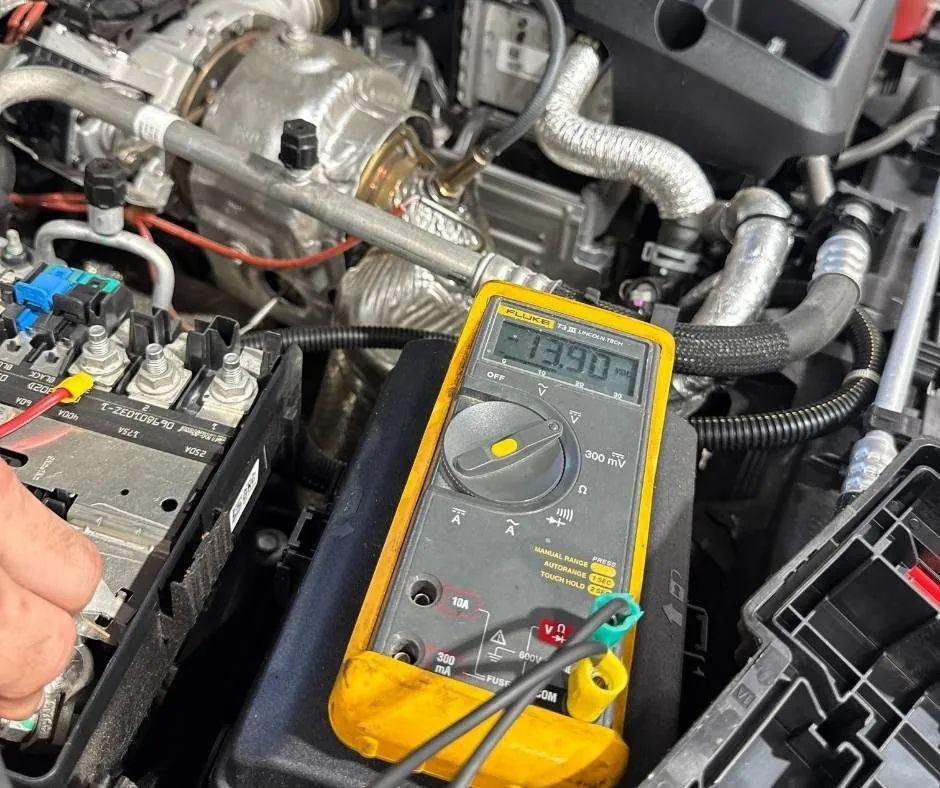
Digital multimeter beside a vehicle battery during electrical testing at Anchor Automotive.
Record what happens between starts
Download the battery symptom log (PDF) · Print a blank copy and keep it with your vehicle records.
Note when you parked, when the next start failed, accessory use, weather, warning messages, and any jump-start. Intermittent faults may require the vehicle to sit, cool down, or complete several operating cycles. Discuss the testing plan and authorization before extended testing.
The timing of the failure changes the test plan
| Pattern | What needs separating | Useful detail |
|---|---|---|
| Dead the next morning | Battery condition, incomplete charging or an overnight key-off load. | Last successful start and how long it was parked. |
| Dead after several days | Normal standby use versus excessive draw and available battery capacity. | Parking duration, accessories and whether the vehicle was locked. |
| Mostly short trips | Whether charging opportunity keeps up with starting and accessory use. | Trip length, frequency and idle time. |
| Problem continues after replacement | Correct application, installation, connections, charging and drain. | Battery replacement date, type and what changed afterward. |
| Normal cranking, but no start | Fuel, ignition, control or mechanical concerns rather than a simple dead-battery assumption. | Cranking behavior and warnings. |
Interstate Batteries: why a car battery dies describes several reasons a battery can become discharged. Your pattern helps choose checks; it does not establish a failed alternator or a parasitic draw by itself.
Battery, starting and charging checks work together
A useful evaluation establishes battery charge and condition, correct application, terminal and cable condition, and system behavior under the relevant load. A connection can look acceptable while losing voltage during cranking. Starter demand, alternator output/control, belt condition and charging-system wiring may also matter.
The specification and charging strategy must match the vehicle; one universal voltage number is not a complete test of every modern charging system. A quick pass result also cannot guarantee remaining battery life or rule out an intermittent fault. Our battery and electrical diagnostics service in Springtown considers the system around the battery.
What a key-off draw means
Modern vehicles retain some electrical activity after shutdown. A parasitic draw becomes a problem when consumption and available charge leave too little energy for the next start. A light, accessory, circuit fault or module that stays awake may be involved, but normal standby current is not automatically a defect.
Delphi: battery-drain testing explains that testing should avoid unnecessarily disturbing electrical systems. Opening a door, unlocking the vehicle or interrupting a circuit can change the conditions being measured. The technician needs to distinguish normal shutdown behavior from an abnormal or intermittent load using the appropriate vehicle procedure—not a single current limit or sleep time for every model.
Why an overnight problem may require longer monitoring
A fault that appears after several hours may not be present during a short appointment. Heat, moisture, vibration, accessory use and communication between modules can change the behavior. The initial investigation may need a controlled shutdown period or a later monitoring stage; that is different from promising a same-day answer.
Ask what the first authorization covers, how long the vehicle may need to remain available and how additional testing will be approved. A useful record states the conditions, observed behavior, circuit investigated and what was rechecked afterward. Ask for the readings and conditions actually captured, including the limits of a short test.
Bring a simple symptom log
- Date and time of the last successful start and the next failed start.
- How long the vehicle sat; whether doors, lights or accessories were used.
- Slow crank, clicks, no crank or normal cranking without starting.
- Battery age/replacement history, recent repairs and added accessories.
- Whether a jump-start helped and whether warnings or accessories behaved unusually.
Do not change normal settings repeatedly just to chase the fault before the appointment. Ask whether the shop wants the usual keys or accessory information. Preserve scan reports and prior invoices. For multiple warning lights, read the check-engine guide; for a concern remaining after earlier repairs, use the second-opinion checklist.
Frequently asked questions
Can a new battery still go dead overnight?
Yes. A draw, insufficient charging, a connection issue or an incorrect/defective battery can remain after replacement. Test the system and the conditions.
Can an alternator pass a quick test and still have a problem?
Yes. Intermittent operation, controls, wiring or connections may not misbehave during a brief test.
How long does battery-drain testing take?
It varies. Shutdown behavior and intermittent loads can require controlled waiting and longer monitoring. Confirm timing and authorization with the shop.
Can low voltage cause multiple warning lights?
Yes. Unstable voltage can affect module operation and communication. It does not prove that every warning has the same cause.
Is cranking normally without starting a dead battery?
Not necessarily. Report the cranking behavior so starting, fuel, ignition or mechanical checks are chosen appropriately.
Keep reading
Service information
Technical references
Manufacturer and industry references support the explanations above. Use the instructions and specifications for your exact vehicle; examples are not universal repair procedures.
Schedule battery and electrical diagnostics
Tell us how long the vehicle sits before it fails and whether the battery has already been replaced. Those details help plan the visit and any longer monitoring it may need.