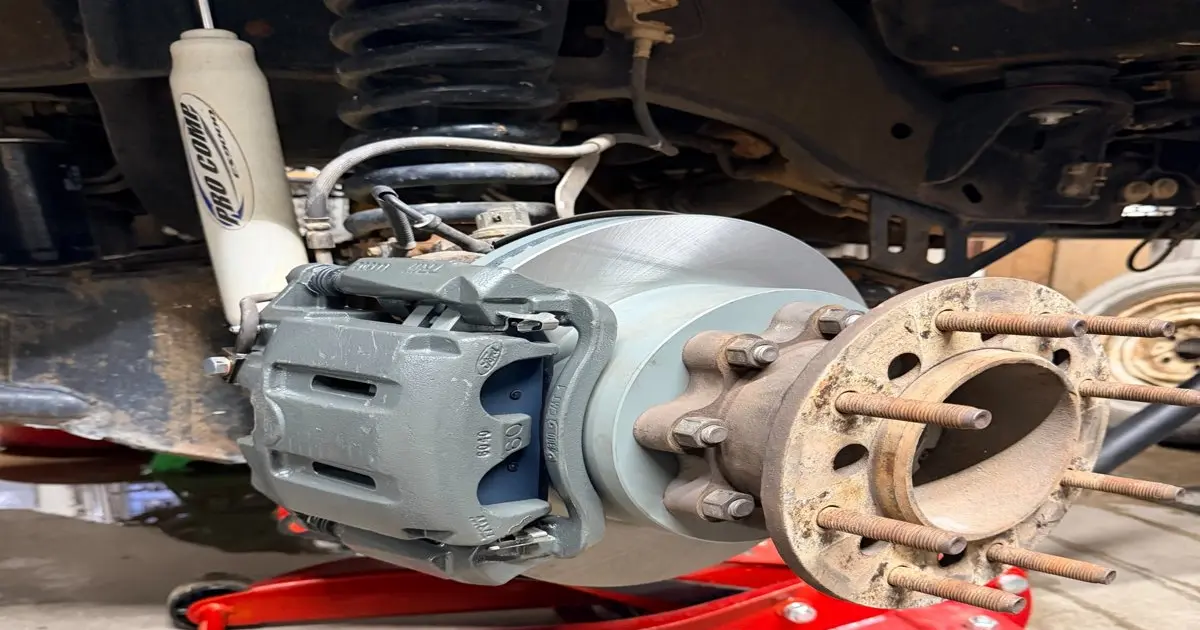
Heavy-duty truck brake rotor and caliper being inspected after repair.
Separate a brief squeak from a change in braking
| What you feel or hear | What an inspection considers |
|---|---|
| Brief squeal after damp parking | Surface moisture or friction vibration may be involved. Persistent or worsening noise still needs inspection. |
| Grinding or scraping | Worn friction material, contact or another mechanical problem; stop and arrange service. |
| Pulsation only during braking | Rotor thickness variation, runout, friction transfer, hub condition or related looseness. |
| Vibration at road speed without braking | Bearing, driveline or handling causes may require a separate investigation. |
| Pull changes when the pedal is pressed | Uneven brake operation, hydraulics or steering/suspension condition. |
Tell us whether you feel the vibration through the pedal, seat or steering wheel. For a constant pull even when you are not braking, see why a vehicle pulls to one side; the two concerns can overlap without being the same failure.
Why “warped rotors” is not a complete explanation
Rotor thickness variation means the disc is not equally thick around its working surface. Runout describes side-to-side movement as a disc or hub turns. Friction transfer, installation condition and caliper behavior can contribute to pulsation too. Delphi: brake judder and thickness variation explains why measurements and related-component checks matter.
A brake inspection at Anchor Automotive can evaluate friction material, rotors or drums, caliper movement, hoses, visible leaks, warning lights and related front-end wear. Replacing rotors without understanding a dragging caliper or mounting issue can leave a contributing problem in place.
Ask to see the finding behind the recommendation
Brembo: minimum brake disc thickness emphasizes that discs wear as well as pads. Remaining thickness and the applicable limit are part of the decision, along with condition, damage and the manufacturer’s procedure. There is no single acceptable rotor measurement for all vehicles.
The following is a blank inspection discussion record, not measured results from a customer vehicle. Ask for the applicable specifications and actual findings to be recorded.
| Item | Record to request | Decision it supports |
|---|---|---|
| Pads or shoes | Actual remaining material and wear pattern: __________. | Whether friction service is due and why wear differs. |
| Rotor or drum | Actual measurement and vehicle-specific limit: __________. | Whether reuse, permitted machining or replacement is appropriate. |
| Caliper, hose and hydraulics | Observed movement, leakage or restriction evidence: __________. | Whether a related fault needs repair. |
| Final recommendation | Approved scope and planned verification: __________. | Which work addresses the complaint and which is separate. |
Pedal changes and warning lamps need context
A soft or low pedal can involve air or a hydraulic problem; a hard pedal can involve assist or other system issues. Those are categories to investigate, not instructions to replace a master cylinder or booster. ABS warnings may involve wheel-speed information, wiring, bearings, voltage or hydraulic/control faults. A red brake warning is not interchangeable with an ABS light: consult the manual and report pedal or stopping changes immediately.
Normal ABS activation can produce a pedal pulse in some situations, but recurring pulsation during ordinary stops should not simply be dismissed as ABS. Do not deliberately trigger a hard stop to diagnose the system.
Before approving brake work
- Ask which measured or observed condition explains the complaint.
- Separate required repair, due maintenance and optional future planning.
- Confirm what the estimate includes: friction parts, hardware, related hydraulic work and any necessary testing.
- Ask how pedal feel, leaks, warning lights and the original symptom will be checked after repair.
Bring the vehicle details, mileage, recent brake or suspension work and whether the problem began suddenly. If it returned after work elsewhere, bring that invoice; the second-opinion guide explains what information helps without assuming anyone made a mistake.
Bring a clean brake inspection worksheet
Download the brake inspection worksheet (PDF) · Print a blank copy and keep it with your vehicle records.
Ask the technician to record actual findings and the applicable vehicle specification. Review the $349.99 per-axle pads-and-rotors package: front or rear for eligible vehicles up to half-ton pickups, with installation labor, hardware, applicable electronic service mode, and brake-life reset included. Performance systems such as Brembo are excluded. The $99.99 fluid flush and bleed is a separate recommended service, including fluid; quote other work before approval.
Prefer the combined service? Our $429.99 brake bundle includes pads and rotors on one axle plus brake-fluid flush and bleed, with installation labor, hardware, brake fluid and applicable service modes/resets. Eligible vehicles through half-ton pickups; performance/Brembo systems are excluded. Taxes and fees are additional.
Frequently asked questions
Can I drive with grinding brakes?
Driving is not recommended. Stop safely and arrange towing because stopping performance and component condition may be compromised.
Do pads always require new rotors?
Not automatically. Measurements, finish, damage, remaining serviceability and the manufacturer’s limits determine the responsible recommendation.
Why does my brake pedal shake?
Thickness variation is one possibility; runout, hub condition, friction transfer or related looseness may contribute. Timing and measurements matter.
Is a short squeal after rain always a serious failure?
Not always, but persistent noise or any change in pedal feel or stopping ability needs inspection. Do not rely on the sound alone.
Keep reading
Service information
Technical references
Manufacturer and industry references support the explanations above. Use the instructions and specifications for your exact vehicle; examples are not universal repair procedures.
Schedule a brake inspection
Describe the noise, pedal feel and whether the vehicle pulls while stopping. If braking is abnormal or the vehicle is grinding, call our Springtown shop to discuss safe transport before coming in.