
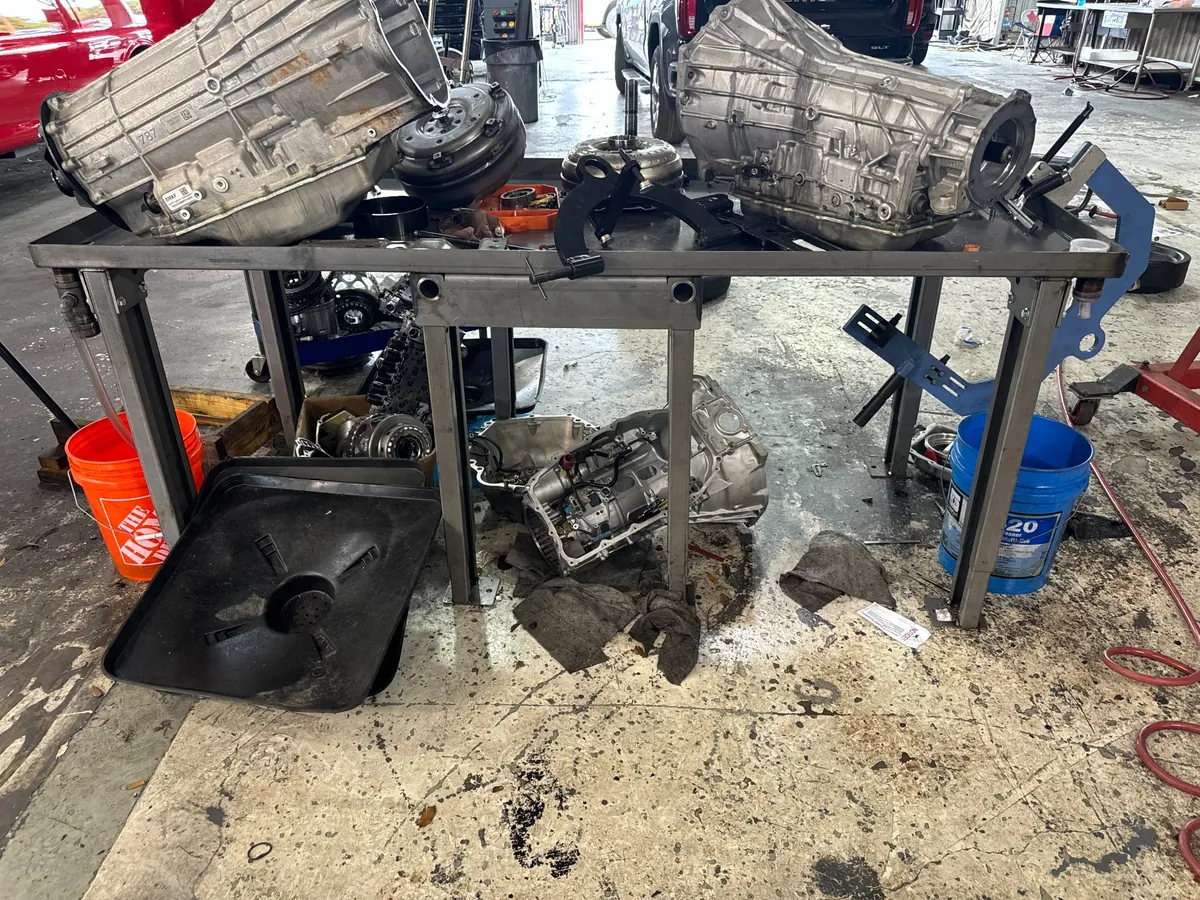
Transmission housings and components on a workbench at Anchor Automotive.
Name the shift behavior as clearly as you can
| Behavior | How to describe it | What may need investigation |
|---|---|---|
| RPM flare or slipping | Engine speed rises without the expected increase in road speed. | Pressure, control, clutch application or internal condition. |
| Delayed engagement | Pause after selecting Drive or Reverse before the vehicle responds. | Fluid supply, hydraulic operation, controls or wear. |
| Harsh shift | A sudden bump during a change of gear. | Commands, pressure strategy, engine data, mounts or mechanical condition. |
| Limp or restricted operation | Limited gears or reduced function with a warning. | The fault triggering protective operation—not just the gear available. |
Record whether it happens cold, fully warm, after a long drive or with a trailer. Do not reproduce an unsafe event simply to collect a video.
What belongs in diagnosis before replacement?
The right fluid type and level, visible leaks, service history and operating data provide a starting point. Depending on the vehicle, testing may also examine system voltage, wiring, speed or load signals, solenoids, valve-body operation, hydraulic pressure and internal wear. An engine-performance problem can affect shift commands, so the transmission is not always the only system involved.
A harsh shift can sometimes occur with a protective control strategy. That does not prove an inexpensive electrical repair will solve it. Our transmission diagnostics and repair service evaluates the cause before comparing appropriate options.
Fluid service is maintenance, not a universal cure
Changing fluid does not restore damaged friction material or repair a mechanical failure. Conversely, an overdue service history alone does not prove a transmission needs replacement. Follow the correct fluid specification, level-check conditions and service procedure. ZF: automatic transmission oil service demonstrates how application-specific oil service is; its instructions and intervals should not be copied onto unrelated transmissions.
Ask the shop to separate scheduled fluid maintenance from the work needed to address slipping. A vehicle-specific maintenance plan can document the former without substituting it for diagnosis.
Compare the installed options and warranty
The diagnosis comes first. Compare total installed cost, expected downtime, remaining vehicle condition, and written coverage for each option that is actually available.
| Option | When to consider it | What your estimate should explain |
|---|---|---|
| Repair the existing unit | Testing identifies a limited fault and the remaining unit is suitable for continued service. | Confirmed fault, repair scope, findings that could change the price, and applicable coverage. |
| Rebuild the existing unit | Inspection shows the core can be rebuilt and the required work is practical. | Disassembly authorization, machining and parts, completion expectations, and rebuild-specific warranty. |
| Install a used unit | A compatible donor unit is available and the total cost fits your plan. | Available donor information, compatibility, inspection and installation scope, and the selected vendor’s actual parts-and-labor warranty. |
| Install a remanufactured unit | A suitable remanufactured assembly is available. | Supplier, supplied components, installation requirements, and specific time, mileage, parts, and labor coverage. |
Standard repairs: parts and labor are covered for two years or 24,000 miles, whichever comes first, under normal driving conditions. Extreme hauling or performance use requires manager approval. Low annual mileage does not extend the two-year limit; seals and bushings can age with time and weather.
Used engines and transmissions: the selected vendor’s actual parts-and-labor coverage, limits, and exclusions appear on the estimate and invoice. Remanufactured units: the selected vendor’s time, mileage, parts, and labor terms appear on the estimate and invoice. Most in-house rebuilds carry two years or 24,000 miles, whichever comes first, but the actual rebuild terms and exceptions must be shown on that estimate.
Review the applicable written coverage and claim instructions before approval. No blanket used-unit or remanufactured-unit term applies to every supplier.
Anchor Automotive warranty overview · Ask about an estimate
What the installed estimate should include
- Assembly supplied: repair, rebuild, used, or remanufactured unit; supplier and included components.
- Labor: removal, installation, and any separately authorized teardown or outside work.
- Supporting parts: torque converter, filters, seals, mounts, and cooler or line work where required for this application.
- Fluids: required specification, quantity, and applicable service charges.
- Setup and verification: programming, relearn, initial setup, leak checks, and operating or road checks where applicable.
- Total and coverage: taxes, fees, core or freight charges, and the written parts-and-labor warranty for the selected option.
These are estimate questions, not a universal parts package. Only the items required and authorized for your vehicle belong in its estimate.
Manual transmission and clutch concerns are different
A manual clutch can slip because of friction wear, contamination or release-system problems. Difficulty selecting gears may involve the clutch hydraulics, linkage, bearings or internal gear/synchronizer condition. SACHS / ZF: clutch slipping illustrates why slipping is not always explained by the friction disc alone.
Describe pedal changes, where engagement occurs, whether shifting changes with the engine off and any leakage or noise you have already noticed. Leave deliberate slip tests to a qualified technician; they can worsen damage.
Bring records and ask about verification
Bring the vehicle and transmission details if known, mileage, fluid-service history, leak observations, exact warnings and previous invoices. Ask how the recommendation explains the original behavior and how it will be rechecked after work under safe conditions. When the same shift complaint has returned after an earlier repair, our second-opinion guide helps organize what is known and what remains uncertain.
Frequently asked questions
Will a fluid change fix slipping?
Not reliably. Fluid service is maintenance; pressure, control, clutch or internal problems require diagnosis and the appropriate repair.
Does a hard shift mean the transmission is ruined?
Not necessarily. Control strategy, hydraulic operation, engine data and mechanical condition all need consideration.
Can an engine problem affect shifting?
Yes. Engine load, throttle information and related faults can influence transmission operation.
Do you evaluate manual transmissions and clutches?
Yes. Anchor Automotive evaluates manual shifting, clutch, hydraulic, bearing and related concerns.
When should I tow it?
Tow for severe slipping, major fluid loss, unreliable movement, overheating or an inability to maintain a safe speed. Call first if unsure.
Keep reading
Service information
Technical references
Manufacturer and industry references support the explanations above. Use the instructions and specifications for your exact vehicle; examples are not universal repair procedures.
Schedule transmission diagnostics
Tell us whether you feel slipping, a delay or a hard shift and when it happens. Bring prior service records so we can discuss a diagnostic starting point before major work.