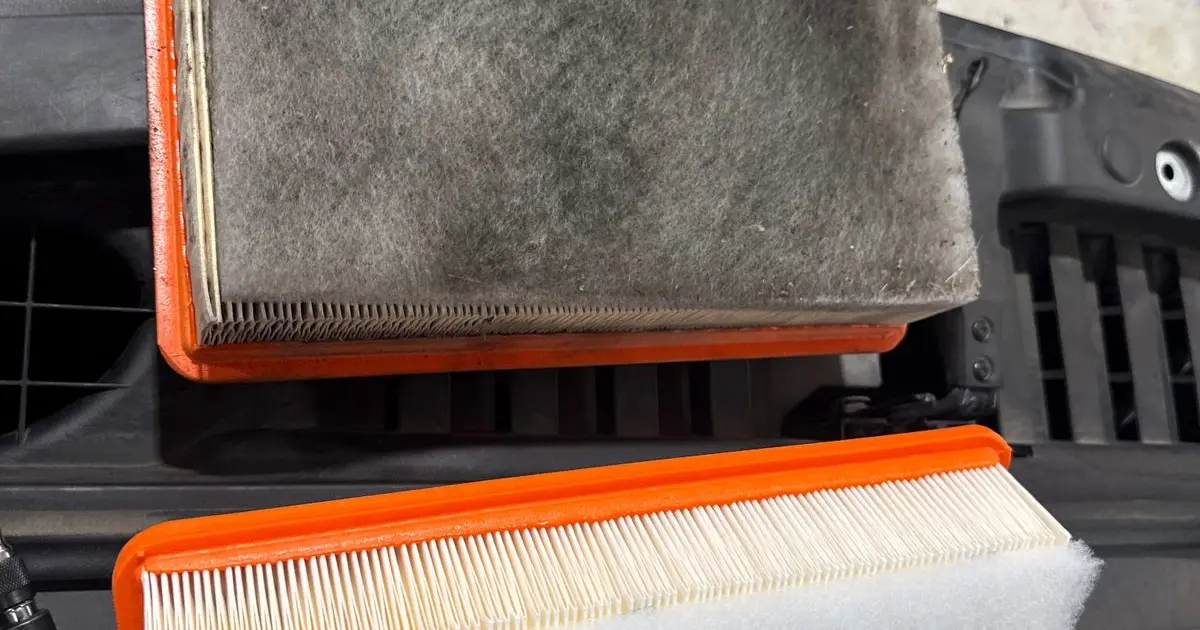
Used and new engine air filters compared during preventive maintenance.
A practical maintenance review plan
This is a review plan, not a universal replacement schedule.
| When | Checklist | Decision |
|---|---|---|
| Monthly and before trips | Lights, wipers, leaks, and accessible fluid levels using the owner’s manual. | Address abnormal findings; do not wait for the next routine visit. |
| At oil service | Oil-life, time, or mileage requirement; brake and suspension condition; visible leaks; filters and battery condition as applicable. | Separate due maintenance from repairs supported by inspection. |
| At the next time or mileage interval | Look up applicable coolant, brake fluid, transmission, axle/transfer case, spark plug, belt, and filter requirements. | Record last service and next due date/mileage for this vehicle. |
| Regular towing, dusty use, or long idling | Review the manufacturer’s special-use schedule and engine-hour rules where specified. | Adjust only the services and intervals that apply. |
Download the maintenance planning worksheet (PDF) · Print a blank copy and keep it with your vehicle records.
Build the schedule around your vehicle
Find the maintenance section for the correct year, engine and drivetrain, including time limits, mileage, oil-life guidance and operating-condition definitions. Record the source, not just the interval someone remembers. A low-mileage vehicle can still reach a time-based service date, while an inspection item is not automatically a replacement item.
Bring available records to our maintenance service in Springtown. Missing history calls for a baseline and priorities, not an assumption that every fluid is overdue. When an exact specification or previous service is unknown, mark it for review instead of guessing.
Use this blank maintenance planning worksheet
This is a blank planning tool, not a universal mileage schedule. Complete one for each vehicle with the applicable manufacturer guidance and verified service history. “Next due” can be a date, mileage, oil-life instruction or an inspection trigger.
| System | Manufacturer interval / specification | Last service | Next due / inspection notes |
|---|---|---|---|
| Engine oil and filter | Record exact guidance | Record date + mileage/hours | Due / inspect / monitor |
| Engine and cabin filters | Record inspection/replacement guidance | Record known history | Condition and use to review |
| Coolant and cooling system | Record fluid specification and schedule | Record known history | Leaks or condition concerns separately |
| Transmission / driveline fluids | Record exact unit and specification | Record known history | Separate due service from shift faults |
| Brakes, suspension and steering | Record inspections and applicable service | Record actual findings | Safety findings and next inspection |
| Plugs, belts and diesel fuel filters | List only items applicable to this vehicle | Record known history | Confirm engine-specific requirements |
Keep invoices with the plan, including the specification used and the vehicle’s mileage at service. Do not fill a missing record with an assumed date or interval.
How towing, idling and dust change the questions
Regular towing and hauling increase demand on multiple systems. Idle time adds engine operation without corresponding road miles. Frequent short trips, dust and unpaved-road use may also matter under the manufacturer’s definitions. Tell the shop how often these conditions occur, not only that the vehicle is driven in Texas.
Ford: special operating-condition maintenance provides one application-specific example that distinguishes primary use from occasional use in demanding conditions. Its intervals are not a schedule for every truck. ZF: automatic transmission oil service also shows why heat, use and the correct transmission procedure matter without establishing one service rule for all units.
If a diesel has active hard-start, power-loss or emissions symptoms, use the diesel diagnostic guide rather than treating a filter or fluid service as a guaranteed cure.
Separate due service, repairs and future planning
- Due service: supported by the correct schedule, time, mileage or oil-life guidance.
- Condition-based repair: a leak, measured wear, warning or other finding that needs its own explanation.
- Monitor or plan: a documented condition or future interval with a reason and a next review point.
Use the fluid specification required for the vehicle. Color or a broad “multi-vehicle” label alone is not enough to choose coolant, transmission, brake, differential or transfer-case fluid. Ask why any recommendation differs from the manual and what evidence supports it.
Plan before a trip, not at the departure deadline
Give the shop the trip date, expected load, trailer use and unresolved symptoms. Allow time for an inspection and any approved follow-up. A practical review may cover visible leaks, fluid levels, cooling concerns, battery/starting behavior, brakes, lights and due service appropriate to the vehicle.
This is planning support, not a safety certification or a guarantee against a breakdown. Business owners coordinating several work vehicles can use our small-fleet maintenance guide to stagger appointments and keep approval contacts clear.
Saturday is for scheduled maintenance
Saturday is for scheduled maintenance only, including oil and filter changes, filters, brakes, fluid services, and A/C evacuation and recharge. Hours are 8:00 AM–2:00 PM Central. Book online; your requested time and service must be confirmed. Request a weekday appointment for diagnostic concerns and major repairs.
Frequently asked questions
Do you perform state emissions testing?
No. Anchor Automotive does not perform state emissions testing or emissions inspections for vehicle registration. We offer mechanical-condition inspections and diagnostic repair. Diesel emissions-system diagnosis is a separate repair service.
Does full-synthetic oil have one fixed change interval?
No. Follow the correct vehicle guidance, including time, operating conditions and oil-life instructions. Oil type alone does not set the interval.
Should every fluid be changed at the same mileage?
No. Each system has its own specification, service guidance and relevant condition.
What maintenance is available Saturday?
Saturday is for scheduled maintenance only, including oil and filter changes, filters, brakes, fluid services, and A/C evacuation and recharge. Hours are 8:00 AM–2:00 PM Central. Book online; your requested time and service must be confirmed. Request a weekday appointment for diagnostic concerns and major repairs.
What if I bought a used truck without records?
Start with the correct schedule, current mileage/use and a baseline inspection. Mark unknown history and prioritize rather than assume every service is overdue.
Why keep maintenance records?
Records show what was done, when, and with which specification. They help plan later service and document required maintenance; coverage still depends on the applicable warranty terms.
Keep reading
Service information
Technical references
Manufacturer and industry references support the explanations above. Use the instructions and specifications for your exact vehicle; examples are not universal repair procedures.
Plan your next maintenance visit
Bring your mileage, service records and a description of towing, idling or daily use. We can discuss what is due and what needs inspection at our Springtown shop.